Books for Financial Literacy: 6 Top Picks to Build Money Skills
We compared six of the most-reviewed personal finance books on Amazon to find the best books for financial literacy, from debt payoff plans to money mindset reads.

In this article
- Who this guide is for
- Top picks at a glance
- How we chose these financial literacy books
- Financial literacy books comparison table
- The Total Money Makeover: Best Overall
- I Will Teach You to Be Rich: Best for Beginners
- The Psychology of Money: Best for Money Mindset
- Rich Dad Poor Dad: Most Popular
- Your Money or Your Life: Best for Long-Term Planning
- Broke Millennial: Best for Young Adults
- Buying guide: what actually matters in a financial literacy book
- Final verdict
Who this guide is for
This guide is for anyone who wants the best books for financial literacy without wading through hundreds of vague "money mindset" titles that never get to the actual math. We evaluated six of the most-reviewed personal finance books on Amazon, weighing real reader review counts, ratings, and how practical (versus purely motivational) each book's advice actually is. Whether you are paying off debt, starting your first budget, or trying to understand why you keep making the same money mistakes, one of these six picks matches where you are right now. Every book below is a real, currently available title, not a curated "best of" list assembled from press releases.
Top picks at a glance
| Award | Product | Best for | |
|---|---|---|---|
| 🏆 Best Overall |  The Total Money Makeover The Total Money Makeover | Step-by-step debt payoff plan | Check Price on Amazon |
| 🥈 Best for Beginners |  I Will Teach You to Be Rich I Will Teach You to Be Rich | A concrete 6-week action plan | Check Price on Amazon |
| 🧠 Best for Money Mindset |  The Psychology of Money The Psychology of Money | Understanding your own behavior around money | Check Price on Amazon |
| ⭐ Most Popular |  Rich Dad Poor Dad Rich Dad Poor Dad | Shifting how you think about assets vs. liabilities | Check Price on Amazon |
| 🌱 Best for Long-Term Planning |  Your Money or Your Life Your Money or Your Life | Reframing spending around financial independence | Check Price on Amazon |
| 🎓 Best for Young Adults |  Broke Millennial Broke Millennial | First-timers navigating credit, debt, and budgeting | Check Price on Amazon |
How we chose these financial literacy books
- Real review volume as a proxy for lasting impact. We prioritized books with tens of thousands of verified Amazon reviews over newer titles with impressive marketing but a thin review base.
- Balance of tactics and mindset. A good financial literacy shelf needs both: books that tell you exactly what to do with your next paycheck, and books that explain why you have not been doing it already.
- Coverage across life stages. We picked titles spanning first-job beginners, people carrying debt, and readers already investing who want to refine their thinking.
- Author credibility and track record. Every author here has a verifiable, long-running body of work in personal finance, not a single viral book with no follow-through.
- One caveat applies to all six: none of these books replace an actual budget you sit down and build. Reading about money habits and building one are two different steps, and skipping the second one is the most common way people finish a finance book and change nothing.
Financial literacy books comparison table
| Book | Core approach | Rating | Reviews | Format | |
|---|---|---|---|---|---|
| The Total Money Makeover | Debt snowball, cash envelopes | 4.7★ | 22,400 | Paperback | Check Price on Amazon |
| I Will Teach You to Be Rich | Automated system, conscious spending plan | 4.6★ | 23,700 | Paperback | Check Price on Amazon |
| The Psychology of Money | Behavioral finance, short essays | 4.7★ | 73,800 | Paperback | Check Price on Amazon |
| Rich Dad Poor Dad | Mindset shift, assets vs. liabilities | 4.7★ | 108,300 | Paperback | Check Price on Amazon |
| Your Money or Your Life | Life energy framework, FI/RE roots | 4.5★ | 6,300 | Paperback | Check Price on Amazon |
| Broke Millennial | Conversational, beginner scripts | 4.6★ | 1,800 | Paperback | Check Price on Amazon |
The Total Money Makeover: Best Overall
Verdict: The clearest, most followable step-by-step plan for getting out of debt and staying out.
Who it's for: Readers carrying credit card or loan debt who want a rigid, no-negotiation system rather than a philosophy to think about.
Dave Ramsey's book lays out his well-known seven "baby steps," starting with a small emergency fund and moving through the debt snowball method, where you pay off your smallest balance first for psychological momentum rather than the mathematically optimal highest-interest debt first. It is opinionated and sometimes blunt, but that rigidity is exactly why it works for people who have tried "just budgeting better" and failed. With over 22,400 reviews and a 4.7-star average, it remains one of the most consistently recommended entry points into serious debt payoff, and the updated edition reflects current interest rates and lending practices rather than decades-old figures.
Pros:
- Extremely clear, sequential steps with no ambiguity about what to do next
- The debt snowball method has strong real-world adherence rates because of the quick wins
- Large community and support ecosystem (courses, forums) built around the same system
Cons:
- The snowball method is not mathematically optimal compared to paying off highest-interest debt first
- Tone can feel preachy or one-size-fits-all for readers who already invest confidently
Who should skip it: If you are debt-free already and want to understand why you spend the way you do rather than what to do next, The Psychology of Money below is a better fit.
I Will Teach You to Be Rich: Best for Beginners

Verdict: The most practical "do this exact thing" book for someone starting from zero.
Who it's for: People in their 20s and 30s who have never automated a budget, opened a Roth IRA, or negotiated a bill, and want a literal script to follow.
Ramit Sethi's book is structured as a six-week program: open the right accounts, automate transfers, negotiate away unnecessary fees, and build a "conscious spending plan" that funds what you actually care about while cutting the rest without guilt. It is less about restriction and more about automation, which is why it holds a 4.6-star rating across more than 23,700 reviews. The book includes exact email and phone scripts for negotiating with banks and credit card companies, something few other finance books bother to include, and it treats investing as something to set up once and largely leave alone rather than actively manage.
Pros:
- Concrete week-by-week action plan with almost no ambiguity
- Includes literal scripts for negotiating fees and rates
- Focuses on automating good habits rather than relying on willpower
Cons:
- Assumes a steady paycheck; less directly useful for irregular or gig income
- Some of the recommended account types and providers have since changed or consolidated
Who should skip it: Readers already deep in debt should start with The Total Money Makeover's payoff structure first before building the automated system this book describes.
The Psychology of Money: Best for Money Mindset

Verdict: The best book for understanding why smart people make bad money decisions.
Who it's for: Readers who already know the mechanics of budgeting or investing but keep sabotaging themselves, or who want the "why" behind financial advice rather than another list of rules.
Morgan Housel's book is a collection of short, focused essays rather than a single continuous argument, each one built around a real historical example of how emotion, ego, and luck shape financial outcomes more than raw intelligence does. It has become one of the most reviewed personal finance titles on Amazon, with more than 73,800 reviews and a 4.7-star average, largely because its lessons apply regardless of income level or which specific budgeting system you use. Unlike tactical books, it will not tell you which account to open, but it reframes concepts like risk tolerance, compounding, and "enough" in ways that make tactical advice from other books easier to actually follow through on.
Pros:
- Short, digestible essay format makes it easy to read in small sessions
- Concepts apply regardless of income level, debt situation, or investing style
- Extremely high review volume reflects broad, lasting relevance
Cons:
- Contains no step-by-step action plan or specific account recommendations
- Some essays repeat similar themes about behavior and luck
Who should skip it: If you need an exact plan rather than a mindset shift, start with I Will Teach You to Be Rich or The Total Money Makeover instead.
Rich Dad Poor Dad: Most Popular

Verdict: The book most people credit with first changing how they think about money, even if its specifics are dated.
Who it's for: Readers who have never really questioned the idea of trading time for a salary and want a foundational mindset shift about assets, liabilities, and financial independence.
Robert Kiyosaki's contrast between his own "poor dad" (a well-educated employee) and his best friend's "rich dad" (a business owner and investor) is built around one core idea: acquire assets that put money in your pocket, and be wary of liabilities disguised as assets, like a home that only costs you money each month. With over 108,300 reviews and a 4.7-star rating, it is by a wide margin the most reviewed book on this list, which reflects how many readers point to it as the first finance book that actually stuck with them. It is light on concrete tactics and heavier on reframing your relationship with work and ownership, which is both its strength and its main limitation.
Pros:
- Extremely widely read, with the largest review base of any book on this list
- Simplifies the asset-versus-liability distinction in a way that is easy to remember
- Effective as a first mindset shift for readers who have never questioned "get a stable job" advice
Cons:
- Some of the specific real estate and business examples are dated and no longer directly applicable
- Offers almost no concrete step-by-step guidance compared to Ramsey's or Sethi's books
Who should skip it: If you already understand the asset-versus-liability concept and want an actual weekly plan, I Will Teach You to Be Rich will get you further faster.
Your Money or Your Life: Best for Long-Term Planning

Verdict: The deepest reframe of what money actually costs you, measured in hours of your life rather than dollars.
Who it's for: Readers thinking about long-term financial independence or early retirement who want to evaluate every purchase against the actual life-hours it costs to earn it.
Vicki Robin and Joe Dominguez's book, revised and updated for 2018, introduces the idea of converting every expense into "hours of life energy" spent earning it, a reframing that has directly influenced much of the modern financial independence and early retirement movement. It holds a 4.5-star rating across 6,300 reviews, a smaller base than some picks here but a consistently loyal one, since the book's nine-step system is meant to be worked through over months rather than read once. It pushes readers to track every dollar earned and spent with unusual precision, which is more demanding upfront than most finance books but produces a genuinely different relationship with spending for people who follow through.
Pros:
- Introduces a genuinely distinct framework (life energy) not found in most other finance books
- Strong influence on and overlap with the modern FIRE (financial independence, retire early) movement
- Nine-step system provides real structure, not just philosophy
Cons:
- The tracking system is more time-intensive than most readers will sustain long-term
- Some investment-specific advice in older editions is dated even after the 2018 revision
Who should skip it: Readers who want quick wins rather than a months-long system should start with The Total Money Makeover instead.
Broke Millennial: Best for Young Adults
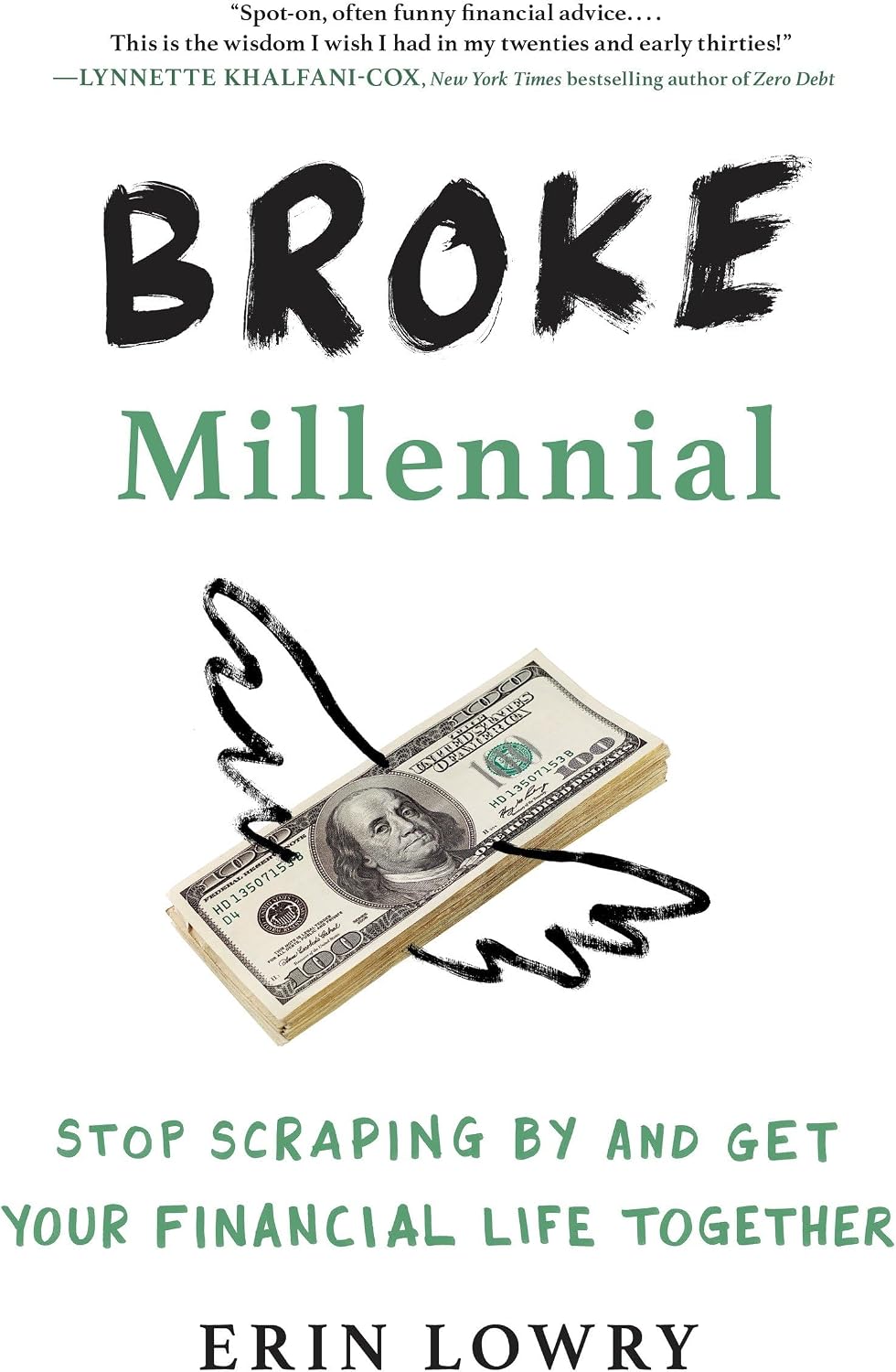
Verdict: The most approachable starting point for someone who has never thought about credit scores, retirement accounts, or splitting bills.
Who it's for: First-time earners, recent graduates, and anyone intimidated by more technical finance books who wants a conversational, judgment-free introduction.
Erin Lowry's book covers the absolute basics, checking accounts, credit scores, student loans, and even the awkward social side of money like splitting rent with roommates or talking about salary with friends, in a tone that reads more like advice from a knowledgeable friend than a finance textbook. It holds a 4.6-star rating across 1,800 reviews, the smallest base on this list but a strong one for its specific audience, since it is explicitly written for readers who feel behind or embarrassed about not already knowing this material. It does not go deep into investing strategy or debt payoff mechanics, but it succeeds at its actual goal: making someone comfortable enough with money basics to pick up a more advanced book next.
Pros:
- Conversational tone specifically aimed at reducing money shame and intimidation
- Covers social and interpersonal money situations most finance books skip entirely
- Genuinely beginner-friendly with no assumed prior knowledge
Cons:
- Lighter on investing depth and debt-payoff mechanics than the more tactical picks on this list
- Smaller review base than the other titles, though ratings are consistently strong
Who should skip it: Readers who already have the basics down and want a specific payoff or investing system should go straight to The Total Money Makeover or I Will Teach You to Be Rich.
Buying guide: what actually matters in a financial literacy book
Match the book to your actual problem, not your aspirations. A reader carrying $15,000 in credit card debt needs a payoff system, not a mindset book about long-term wealth. Be honest about whether you need tactics or perspective first.
Look for books with a concrete action step, not just principles. The most useful financial literacy books give you something to actually do this week, whether that is automating a transfer, tracking an expense, or making a phone call to negotiate a rate. Books that stay purely conceptual are easier to finish and easier to forget.
Check how recently a book was updated. Interest rates, tax brackets, and specific account types change. Several titles on this list have been revised in the last decade specifically to keep dollar figures and account recommendations current, which matters more than it seems.
Review volume is a genuine signal, but read the actual complaints, not just the star average. A book with 100,000 reviews and a 4.7 average still has thousands of one- and two-star reviews worth skimming, since they often reveal exactly which type of reader the book does not suit.
Plan to reread key chapters, not just read once. Almost every book on this list is designed to be referenced repeatedly as your financial situation changes, not consumed once and shelved. The debt payoff steps in The Total Money Makeover, for instance, are meant to be checked against your actual numbers monthly, not skimmed once.
Final verdict
The Total Money Makeover is the strongest overall pick for most readers, because its debt snowball system gives you a specific, sequential plan rather than general principles, and its review base backs up that it actually works for a wide range of financial situations. The Psychology of Money is the best complement or alternative for readers who already have the tactics down and need to understand the behavioral side of why they keep making the same money mistakes despite knowing better.
Frequently asked questions
What is the best book to start with for financial literacy?
For most beginners, I Will Teach You to Be Rich is the easiest starting point because it gives a concrete six-week action plan for opening accounts, automating savings, and building a spending plan. If you are already carrying debt, start with The Total Money Makeover instead, since its debt snowball system is built specifically for that situation.
Is Rich Dad Poor Dad still worth reading in 2026?
Yes, for the mindset shift around assets versus liabilities, which is why it remains the most reviewed personal finance book on Amazon with over 108,000 reviews. Some of its specific real estate and business examples are dated, so pair it with a more tactical book like I Will Teach You to Be Rich for current, actionable steps.
Do I need to read more than one financial literacy book?
Most readers benefit from at least two: one tactical book that tells you exactly what to do with your money, and one behavioral book like The Psychology of Money that explains why you have not been doing it already. Tactics without understanding your own habits tend not to stick.
What is the debt snowball method mentioned in The Total Money Makeover?
The debt snowball method means paying off your smallest debt balance first regardless of interest rate, then rolling that payment into the next smallest balance. It is not the mathematically fastest way to pay off debt, but the quick wins keep people motivated enough to actually finish the plan.
Is Your Money or Your Life only for people who want to retire early?
No. Its core idea, converting expenses into hours of life energy spent earning them, is useful for anyone who wants to spend more deliberately, even without a specific early retirement goal. It does require more detailed expense tracking than most other books on this list.
Are these books useful if I already have a financial advisor?
Yes. These books build the underlying literacy to understand and question advice you are given, rather than replacing professional guidance. The Psychology of Money in particular helps explain your own reactions to market volatility or spending decisions that a purely numbers-based conversation with an advisor will not cover.