
6 Best Golf Balls for Beginners in 2026 (Most Forgiving Picks)
Six low-compression golf balls built for beginner swing speeds, compared on feel, durability, and verified review data to find the most forgiving picks for new golfers.

In this article
- Who this guide is for
- Top picks at a glance
- How we chose these golf balls
- Golf ball comparison table
- Callaway Golf Supersoft: Best Overall
- TaylorMade Noodle Long & Soft: Best Value
- Titleist TruFeel: Best for Slower Swings
- Bridgestone e6: Best for Durability
- Srixon Soft Feel: Best Soft Feel
- Wilson Duo Soft: Best All-Rounder
- Buying guide: what actually matters in a golf ball for beginners
- Final verdict
Who this guide is for
This guide is for beginner golfers who are tired of losing expensive premium balls in the water, the rough, or the trees before they ever get a chance to feel the difference between a $5 ball and a $1 ball. We evaluated six of the best golf balls for beginners based on compression, feel, durability, and verified review data from thousands of real buyers, not marketing copy. If you slice, hook, or just haven't found your swing tempo yet, low-compression, forgiving balls like these help you get more distance out of a slower swing speed while keeping the cost of a bad round manageable. None of these are tour-level balls built for spin control around the green; they are built to forgive mishits and get new players enjoying the game faster.
Top picks at a glance
| Award | Product | Best for | |
|---|---|---|---|
| 🏆 Best Overall |  Callaway Golf Supersoft Callaway Golf Supersoft | Overall low-compression forgiveness | Check Price on Amazon |
| 💰 Best Value |  TaylorMade Noodle Long & Soft TaylorMade Noodle Long & Soft | Budget-friendly practice rounds | Check Price on Amazon |
| ⛳ Best for Slower Swings |  Titleist TruFeel Titleist TruFeel | Straight shots with soft feel | Check Price on Amazon |
| 🎯 Best for Durability |  Bridgestone e6 Bridgestone e6 | Straighter flight, fewer slices | Check Price on Amazon |
| 🧡 Best Soft Feel |  Srixon Soft Feel Srixon Soft Feel | Greenside touch on a budget | Check Price on Amazon |
| 🌤️ Best All-Rounder |  Wilson Duo Soft Wilson Duo Soft | Longest carry for the price | Check Price on Amazon |
How we chose these golf balls
- Compression rating: we prioritized low-compression cores (around 35 to 60) because slower beginner swing speeds compress a firm ball less efficiently, costing distance.
- Verified review volume and rating: every ball on this list has hundreds to thousands of real Amazon buyer reviews backing up its rating, not a handful of seeded reviews.
- Cover durability: ionomer covers that resist scuffing matter more to a beginner losing balls to cart paths and mishits than a soft urethane cover built for tour spin.
- Straight-flight design: dimple patterns and core construction that reduce slice and hook tendencies, since beginners lose more strokes to direction than distance.
- Price per dozen: none of these require a second mortgage, because beginners lose balls at a much higher rate than experienced players.
None of these picks will fix a fundamentally broken swing; the right ball just removes one variable so you can focus on technique instead of fishing balls out of the pond.
Golf ball comparison table
| Product | Compression / feel | Rating | Reviews | Pack size | |
|---|---|---|---|---|---|
| Callaway Golf Supersoft | 38 compression, ultra-soft | 4.8★ | 6,500 | 12-pack | Check Price on Amazon |
| TaylorMade Noodle Long & Soft | 34 compression, soft | 4.7★ | 2,700 | 15-pack | Check Price on Amazon |
| Titleist TruFeel | Low compression, soft feel | 4.8★ | 292 | 12-pack | Check Price on Amazon |
| Bridgestone e6 | Low compression, gradational core | 4.8★ | 746 | 12-pack | Check Price on Amazon |
| Srixon Soft Feel | 60 compression, soft ionomer cover | 4.8★ | 1,100 | 12-pack | Check Price on Amazon |
| Wilson Duo Soft | 35 compression, ultra-low | 4.7★ | 1,000 | 12-pack | Check Price on Amazon |
Callaway Golf Supersoft: Best Overall
Verdict: the most consistently recommended beginner ball for a reason, and the review count proves it.
Who it's for: beginners and mid-handicappers who want maximum forgiveness and distance without thinking about ball selection at all.
The Supersoft uses a 38 compression core, one of the lowest on the market, paired with a durable ionomer cover that resists scuffs from cart paths and mishit irons. It's backed by 6,500 reviews at a 4.8 star average and over 10,000 units bought in the past month alone, which is a strong signal this ball performs consistently across a huge range of swing speeds, not just for a lucky subset of reviewers. The larger core also reduces sidespin, meaning a beginner's slice or hook shows up less dramatically off the tee.
Pros:
- Extremely low compression suits slow-to-moderate swing speeds
- Durable cover holds up over dozens of rounds
- Massive verified review base backs up consistent real-world performance
Cons:
- Less short-game spin control than a premium urethane ball
- Not ideal once your swing speed increases past 90 mph, where firmer balls perform better
Who should skip it: low-handicap or fast-swing players who need more spin around the green should look at the Srixon Soft Feel instead, which balances a bit more control with still-forgiving compression.
TaylorMade Noodle Long & Soft: Best Value

Verdict: the cheapest way to try low-compression golf balls without compromising on real performance.
Who it's for: beginners who lose several balls per round and don't want each lost ball to sting financially.
At a 34 compression core, the Noodle is one of the softest balls on this list, built specifically to maximize distance for slower swing speeds while keeping cost per ball low. It carries 2,700 reviews at a 4.7 star rating, and the patented dimple design is engineered specifically to counteract sidespin, which helps straighten out the slices that plague most new players. The 15-ball pack size (instead of the usual dozen) also means fewer trips back to buy more when you inevitably lose a few in the water.
Pros:
- Lowest price per ball on this list
- 15-ball pack stretches further than a standard dozen
- Dimple pattern specifically engineered to reduce slice
Cons:
- Softer cover scuffs faster than the pricier options here
- Noticeably less feel on chips and putts compared to the Srixon or Titleist picks
Who should skip it: players who already have decent contact and want a ball that will last through more rounds should go with the Bridgestone e6 instead, which holds up to more abuse.
Titleist TruFeel: Best for Slower Swings

Verdict: Titleist's most forgiving ball brings premium brand construction to a beginner-friendly price.
Who it's for: beginners who want the credibility of the Titleist name with a core built for slower, developing swings.
TruFeel's low-compression core is Titleist's answer to golfers who aren't generating tour-level clubhead speed yet, and it shows in the numbers: a 4.8 star rating across 292 reviews and nearly 7,000 units bought in the last month. The soft compression helps the ball get airborne more easily off shorter or slower swings, and the 342 dimple design is tuned for a penetrating, straighter ball flight rather than the high spin a low-handicapper would want. It's a ball you can grow into as your swing improves, since Titleist also makes higher-compression versions in the same family.
Pros:
- Trusted Titleist quality control and construction
- Soft compression helps slower swings generate more carry distance
- Straighter flight pattern reduces the visual impact of off-center hits
Cons:
- Costs more per dozen than the Noodle or Wilson options
- Reviews, while excellent, are a smaller sample than the Callaway Supersoft
Who should skip it: budget-focused beginners should start with the TaylorMade Noodle instead and upgrade to TruFeel once they're more confident with contact.
Bridgestone e6: Best for Durability

Verdict: built around Bridgestone's gradational compression core specifically to correct slices, and it holds up round after round.
Who it's for: beginners whose biggest miss is a slice off the tee and who want a ball that survives more than a few rounds.
The e6's defining feature is its gradational compression core, which is engineered to reduce sidespin on off-center hits more than a standard core, directly targeting the slice that plagues most new golfers. It carries a 4.8 star rating across 746 reviews, and buyers consistently note that the cover resists scuffing better than typical low-compression balls, which matters when a beginner's mishits are hitting the ball off-center more often. Over 2,000 units were bought in the past month, a solid signal of ongoing demand from golfers specifically hunting for anti-slice performance.
Pros:
- Gradational core specifically engineered to reduce slice
- More durable cover than most soft-compression competitors
- Strong, consistent review rating across hundreds of verified buyers
Cons:
- Fewer reviews than the market-leading Callaway Supersoft
- Slightly firmer feel around the green than the Srixon Soft Feel
Who should skip it: golfers whose miss is a hook rather than a slice may not see the same directional benefit and should consider the Callaway Supersoft's more neutral core instead.
Srixon Soft Feel: Best Soft Feel

Verdict: the best balance on this list between beginner-friendly compression and enough greenside feel to notice the difference.
Who it's for: beginners who are starting to develop a short game and want more feedback on chips and putts than a pure distance ball provides.
Srixon built the Soft Feel around a 60 compression core, higher than the Callaway or Wilson picks but still well below a tour ball, striking a middle ground that gives more feel on and around the green while remaining easy to compress off the tee. It holds a 4.8 star rating across 1,100 reviews, with over 3,000 units bought in the past month, and its soft ionomer cover is specifically tuned for a softer feel at impact than a typical distance ball. For a beginner starting to care about short-game touch rather than just distance, this is the pick that bridges both needs.
Pros:
- Noticeably better greenside feel than pure distance balls
- Strong, consistent 4.8 star rating across over 1,000 reviews
- Soft ionomer cover balances feel with reasonable durability
Cons:
- Slightly less forgiving off the tee than the lower-compression Callaway or Wilson
- Costs a little more than the TaylorMade Noodle
Who should skip it: absolute beginners who care only about tee-shot distance and forgiveness should start with the Callaway Supersoft instead.
Wilson Duo Soft: Best All-Rounder
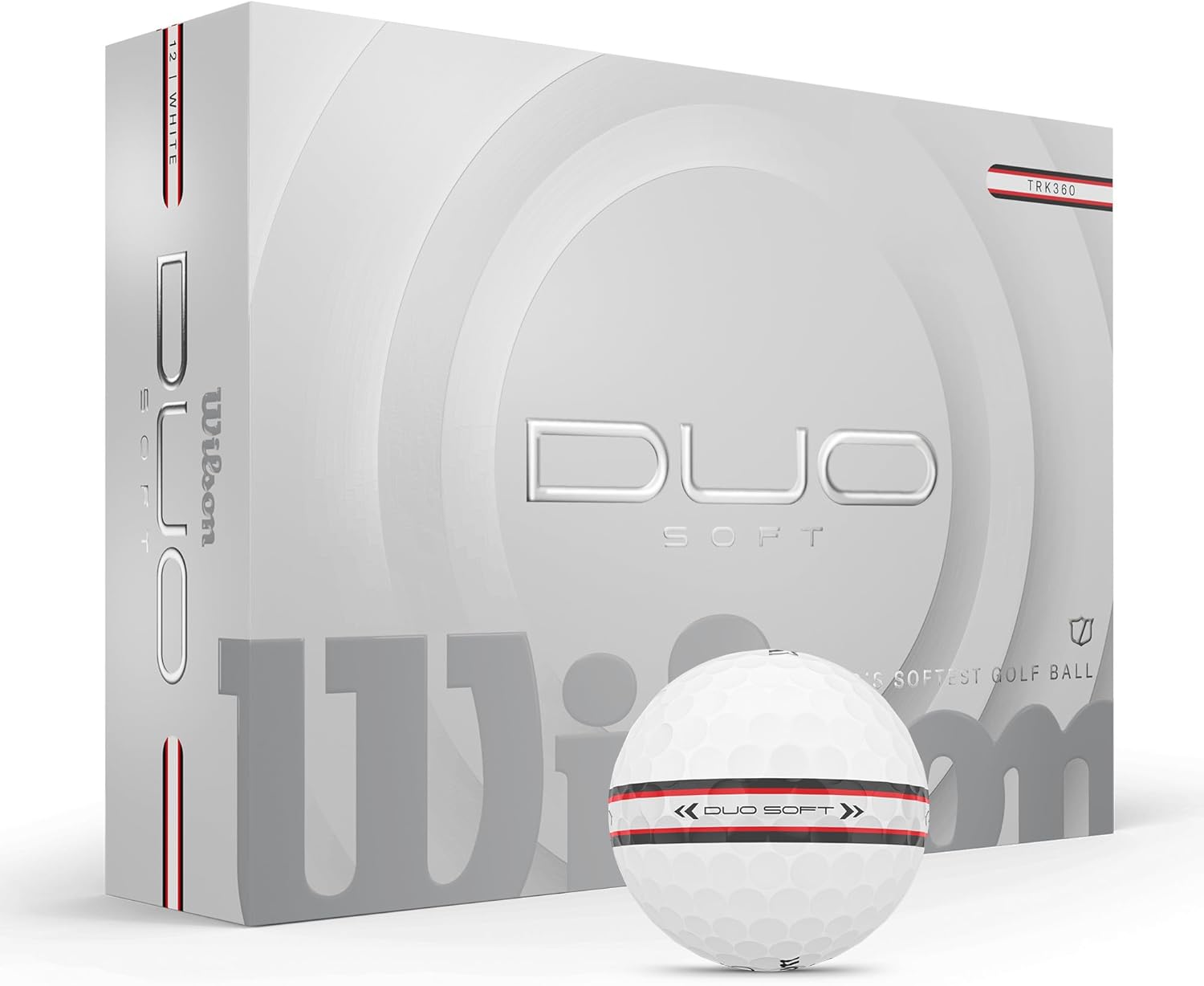
Verdict: one of the lowest compression cores on the market, purpose-built to squeeze extra carry distance out of a slower swing.
Who it's for: beginners whose main frustration is not getting enough distance off the tee, especially with a driver swing under 90 mph.
The Duo Soft's 35 compression core is among the lowest of any ball on this list, engineered specifically around the principle that a softer core compresses more efficiently at slower swing speeds, translating directly into extra yards. It holds a 4.7 star rating across 1,000 reviews, with over 1,000 units bought in the past month, and reviewers consistently cite noticeably longer drives compared to firmer balls in the same price range. It's a genuine all-rounder: soft enough to help beginners, priced low enough to not worry about losing a few, and consistent enough in reviews to trust across a full bag.
Pros:
- Among the lowest compression cores available, ideal for slower swings
- Reasonable price point for a 12-pack
- Consistent 4.7 star rating across 1,000 verified reviews
Cons:
- Cover durability is a step below the Bridgestone e6
- Less brand recognition than Titleist or Callaway, though the specs hold up
Who should skip it: players who already generate solid clubhead speed and don't need extra compression assistance should look at the Srixon Soft Feel for more all-around feel instead.
Buying guide: what actually matters in a golf ball for beginners
Compression rating matters more than any other spec for a beginner. Lower compression cores (30 to 60) deform more easily at impact, which transfers energy more efficiently into distance when your swing speed is still developing. A high-compression tour ball on a slow swing simply won't compress enough to release its full energy, costing you yards for no benefit.
Cover material affects both durability and feel. Ionomer covers, used on every ball in this guide, are more durable and cheaper to replace than the soft urethane covers found on tour-level balls. Urethane gives better spin control around the green but scuffs and cuts far more easily, which matters when you're still learning to make clean contact.
Dimple pattern influences flight forgiveness. Some manufacturers, like Bridgestone and TaylorMade, design dimple patterns specifically to reduce sidespin on off-center hits, which shows up as a straighter ball flight even on a mishit. This matters more for a beginner than for an experienced player who already controls spin through swing mechanics.
Price per ball should reflect how often you actually lose balls. New golfers lose significantly more balls per round than experienced players, so spending $4 to $5 per ball on a premium tour ball rarely makes financial sense until your accuracy improves. A $1.50 to $2.50 per ball range, which every pick on this list falls into, is the realistic sweet spot.
Pack size and bulk buying reduce your effective cost. Options like the 15-ball TaylorMade Noodle pack or buying two dozen of any of these picks at once bring the per-ball cost down further, which matters more to a beginner's wallet than to their scorecard.
Final verdict
For most beginners, Callaway Golf Supersoft is the safest starting point: its low compression, durable cover, and 6,500-review track record make it hard to go wrong with. If budget is the deciding factor, TaylorMade Noodle Long & Soft delivers nearly the same forgiveness at a lower price per ball and comes with three extra balls per pack to offset the ones you'll inevitably lose.
Frequently asked questions
What golf ball compression is best for beginners?
Beginners with slower swing speeds should look for low-compression balls in the 30 to 60 range, such as the Callaway Supersoft (38 compression) or the Wilson Duo Soft (35 compression). Lower compression cores deform more easily at impact, which helps transfer energy into distance even without a fast swing.
Do cheaper golf balls actually perform worse than premium ones?
Not for beginners. Premium tour balls like the Titleist Pro V1 are built for players who already generate enough clubhead speed to compress a firmer core and who need advanced short-game spin control. Beginners typically get more real-world benefit from a low-compression distance ball costing a fraction of the price.
How many golf balls should a beginner buy at once?
New golfers lose balls at a much higher rate than experienced players, so buying two or three dozen at a time, or a larger pack like the 15-ball TaylorMade Noodle set, is more cost-effective than repeatedly buying a single dozen.
Can a golf ball actually help reduce my slice?
Yes, to a degree. Balls like the Bridgestone e6 use a gradational compression core and dimple pattern specifically engineered to reduce sidespin on off-center hits, which can make a slice noticeably less severe. It will not fully correct a swing fault, but it reduces how much that fault costs you in direction.
What is the difference between a distance ball and a soft feel ball?
Distance balls, like the TaylorMade Noodle or Callaway Supersoft, prioritize low compression and maximum carry off the tee. Soft feel balls, like the Srixon Soft Feel, use a slightly firmer core paired with a soft cover to give more feedback on chips and putts, while still remaining forgiving enough for developing swings.
Is it worth buying name-brand golf balls as a beginner?
Brand name balls from Titleist, Callaway, or Bridgestone typically have larger, more consistent quality control processes and larger verified review bases backing up their performance claims. For a beginner, this consistency matters more than any marginal performance gain from a specific brand.


