
Best Leather Sewing Machine for Thick Leather (2026 Buying Guide)
Heavy duty home machines and true industrial walking foot machines compared to find the best leather sewing machine for thick leather, from budget picks to full industrial setups.

In this article
- Who this guide is for
- Top picks at a glance
- How we chose these leather sewing machines
- Leather sewing machine comparison table
- SINGER 4452 Heavy Duty Sewing Machine: Best Overall
- Consew 206RB-5 Walking Foot Industrial Sewing Machine: Best for Thick Leather
- SINGER 4411 Heavy Duty Sewing Machine: Best Budget
- VEVOR Industrial Lockstitch Sewing Machine: Best Commercial Value
- IRONWALLS Leather Cobbler Manual Stitching Machine: Best for Beginners
- Consew CP206RL Portable Walking Foot Machine: Best Portable Walking Foot
- Buying guide: what actually matters in a leather sewing machine
- Final verdict
Who this guide is for
This guide is for anyone who has burned out a regular sewing machine trying to stitch a leather belt, wallet, holster, or tack repair and needs a machine actually built for the job. We looked at machines ranging from home-use heavy duty models to true walking foot industrial units, comparing motor power, feed mechanism, needle penetration, and verified owner review data to find the best leather sewing machine for thick leather at every budget. If you are patching a jacket seam once a year, you need a different machine than a hobbyist making full-grain wallets weekly, and a different machine again from a small shop doing saddle repair daily. We evaluated all three cases below.
Top picks at a glance
| Award | Product | Best for | |
|---|---|---|---|
| 🏆 Best Overall |  SINGER 4452 Heavy Duty Sewing Machine SINGER 4452 Heavy Duty Sewing Machine | Garment leather, upholstery weight fabric, thick denim | Check Price on Amazon |
| 🥇 Best for Thick Leather |  Consew 206RB-5 Walking Foot Industrial Consew 206RB-5 Walking Foot Industrial | Saddlery, tack, multi-layer belts, bags | Check Price on Amazon |
| 💰 Best Budget |  SINGER 4411 Heavy Duty Sewing Machine SINGER 4411 Heavy Duty Sewing Machine | Thin to mid-weight leather, canvas repairs | Check Price on Amazon |
| 🏭 Best Commercial Value |  VEVOR Industrial Lockstitch Sewing Machine VEVOR Industrial Lockstitch Sewing Machine | Small workshops moving up from home machines | Check Price on Amazon |
| 🔰 Best for Beginners |  IRONWALLS Leather Cobbler Manual Machine IRONWALLS Leather Cobbler Manual Machine | Cobbling, small crafts, no electricity needed | Check Price on Amazon |
| 🚶 Best Portable Walking Foot |  Consew CP206RL Portable Walking Foot Machine Consew CP206RL Portable Walking Foot Machine | Table-top industrial power without a full stand | Check Price on Amazon |
How we chose these leather sewing machines
- Feed system: we prioritized machines with a walking foot or compound feed for anything rated for thick leather, since a standard drop feed slips on stiff hides.
- Motor and needle penetration power: heavy duty home machines need at least 50% more piercing power than a standard machine; industrial units need a dedicated servo motor.
- Verified review volume and rating: every pick below has real, current Amazon review counts and ratings, not manufacturer marketing copy.
- Price-to-capability fit: we split picks across home-use, small workshop, and true industrial tiers rather than assuming everyone needs (or can afford) a full industrial table setup.
- One caveat that applies to every machine here: thick leather also needs the right needle size and thread weight for that machine, or even the best hardware will skip stitches and break needles.
Leather sewing machine comparison table
| Product | Key spec | Rating | Reviews | Price tier | |
|---|---|---|---|---|---|
| SINGER 4452 | 1100 stitches/min, 32 stitches, metal frame | 4.4★ | 11,300 | Mid | Check Price on Amazon |
| Consew 206RB-5 | Walking foot, table + servo motor included | 4.3★ | 117 | Industrial | Check Price on Amazon |
| SINGER 4411 | 1100 stitches/min, 50% more power, metal frame | 4.4★ | 9,000 | Budget | Check Price on Amazon |
| VEVOR Industrial Lockstitch | 550W servo motor, 5000 SPM, table stand included | 4.0★ | 122 | Commercial | Check Price on Amazon |
| IRONWALLS Cobbler Manual | Hand-crank, no electricity, portable | 3.6★ | 416 | Budget | Check Price on Amazon |
| Consew CP206RL | Portable walking foot, table-top industrial motor | 3.6★ | 192 | Industrial | Check Price on Amazon |
SINGER 4452 Heavy Duty Sewing Machine: Best Overall
Verdict: the best balance of leather-capable power and everyday usability for most home sewers.
Who it's for: hobbyists and small-batch makers stitching garment-weight leather, upholstery vinyl, or multiple layers of thick denim on a home budget.
The SINGER 4452 delivers 50% more piercing power than a standard machine along with a full metal interior frame that keeps the machine stable when driving a needle through stacked leather. It runs at 1,100 stitches per minute with 32 built-in stitches and a 1-step buttonhole, and it has built up a genuinely large track record: over 11,300 verified Amazon reviews at a 4.4-star average, which is a far larger sample size than most of the industrial machines on this list. It won't replace a true walking foot industrial machine on multi-layer saddlery, but for anyone sewing belts, wallets, or light upholstery at home, it is the most proven option here.
Pros:
- 50% more piercing power than a standard home machine
- Large, verified review base backing up its reliability claims
- 1-step buttonhole and needle threader make it easy to actually use daily
Cons:
- No walking foot, so very thick or slick leather can still slip under the presser foot
- Not designed for continuous industrial-duty use
Who should skip it: anyone stitching vegetable-tanned leather over 6-8 oz thick or doing saddlery work should go straight to the Consew 206RB-5 below instead.
Consew 206RB-5 Walking Foot Industrial Sewing Machine: Best for Thick Leather

Verdict: the closest thing to a shop-grade machine you can buy as a complete table-and-motor package.
Who it's for: makers doing regular saddlery, tack, multi-layer bag straps, or anyone who has outgrown a home machine's capacity entirely.
This is a true walking foot lockstitch machine, meaning the upper and lower feed dogs move the material together instead of relying on a single feed dog to drag stiff leather through. That eliminates the slipping and uneven stitch length that ruins a leather project on a standard machine. It ships as a complete unit with an industrial table and a dedicated servo motor, not just a head, which matters because a bare industrial head with the wrong table setup is a common beginner mistake. Owners rate it 4.3 stars across 117 verified reviews, consistent for a niche industrial product at this price point.
Pros:
- True walking foot feed handles thick, multi-layer leather without slipping
- Complete table and servo motor package, no separate sourcing needed
- Built for continuous industrial-duty cycles, not occasional home use
Cons:
- Significant footprint and price jump compared to home-use machines
- Overkill for anyone only doing occasional light leather repairs
Who should skip it: if you are only patching the occasional wallet or belt, the SINGER 4452 above will handle it for a fraction of the cost and counter space.
SINGER 4411 Heavy Duty Sewing Machine: Best Budget

Verdict: the cheapest machine here that can still credibly handle thin to mid-weight leather.
Who it's for: first-time leathercraft hobbyists who want to test the waters before investing in a heavier machine.
The 4411 shares the same core heavy-duty motor and metal frame construction as the pricier 4452, just with fewer built-in stitches (11 versus 32) and a simpler 4-step buttonhole instead of 1-step. It still delivers 50% more power than a standard machine and runs at the same 1,100 stitches per minute. With over 9,000 verified reviews at a 4.4-star average, it has one of the largest and most consistent review bases of any machine in this comparison, home or industrial. For anyone unsure whether leatherwork is a hobby they'll stick with, this is the lowest-risk entry point that still has real leather-handling capability.
Pros:
- Lowest price point of any machine on this list with genuine heavy-duty power
- Enormous, consistently high-rated review base
- Metal frame construction rather than plastic internals
Cons:
- Fewer built-in stitches and a more basic buttonhole function than the 4452
- Same drop-feed limitation as the 4452 on very thick or slick leather
Who should skip it: anyone who already knows they'll be working with heavier hides regularly should spend the extra money on the SINGER 4452 or the Consew 206RB-5 instead.
VEVOR Industrial Lockstitch Sewing Machine: Best Commercial Value

Verdict: the most affordable true industrial setup for a small workshop stepping up from home equipment.
Who it's for: small shops or serious hobbyists ready for a dedicated servo-motor machine but not ready for Consew-level pricing.
This VEVOR ships as a complete commercial set including a 550W servo motor and table stand, capable of running up to 5,000 stitches per minute (roughly 4.5 times faster than either SINGER above), with a metal frame and LCD control panel. Amazon lists it specifically for cotton, wool, denim, leather, and canvas, and it holds a 4.0-star rating across 122 verified reviews, a solid result for a newer entrant in the industrial sewing category. It's a meaningfully cheaper way into true industrial speed and motor power than the established Consew line, at the cost of a shorter track record.
Pros:
- True industrial servo motor and speed at a fraction of Consew pricing
- Complete table stand and motor set, not a bare head
- LCD panel makes speed and settings easier to dial in than older analog controls
Cons:
- Shorter overall track record than long-established industrial brands
- Standard presser foot, not a true walking foot, so very thick leather still benefits from the Consew 206RB-5 instead
Who should skip it: anyone doing daily saddlery or multi-layer leather work should prioritize the walking foot on the Consew 206RB-5 over this machine's extra speed.
IRONWALLS Leather Cobbler Manual Stitching Machine: Best for Beginners

Verdict: a genuinely useful no-electricity option for small repairs and true beginners.
Who it's for: anyone doing occasional shoe, bag, or small leather craft repairs who doesn't want to commit to a powered machine yet.
This is a hand-crank manual stitcher, not an electric machine, which makes it fully portable and usable anywhere without a power outlet. It comes with needles included and is marketed for canvas, cotton, linen, bags, and cloth repair in addition to leather cobbling. With 3.6 stars across 416 verified reviews, it's rated lower than the powered machines on this list, which reflects the real learning curve of hand-crank stitching rather than a defect; most negative reviews describe user setup issues rather than hardware failure. For light, occasional use it remains the lowest-cost, most portable entry point into leather stitching.
Pros:
- No electricity required, fully portable
- Lowest price point among all dedicated leather-stitching options here
- Includes needles and works across multiple thick materials, not just leather
Cons:
- Noticeably lower average rating than every powered machine on this list
- Slower and more physically demanding than any electric option
Who should skip it: anyone planning regular or high-volume leather sewing should go with the SINGER 4411 instead for a similar price with an electric motor.
Consew CP206RL Portable Walking Foot Machine: Best Portable Walking Foot
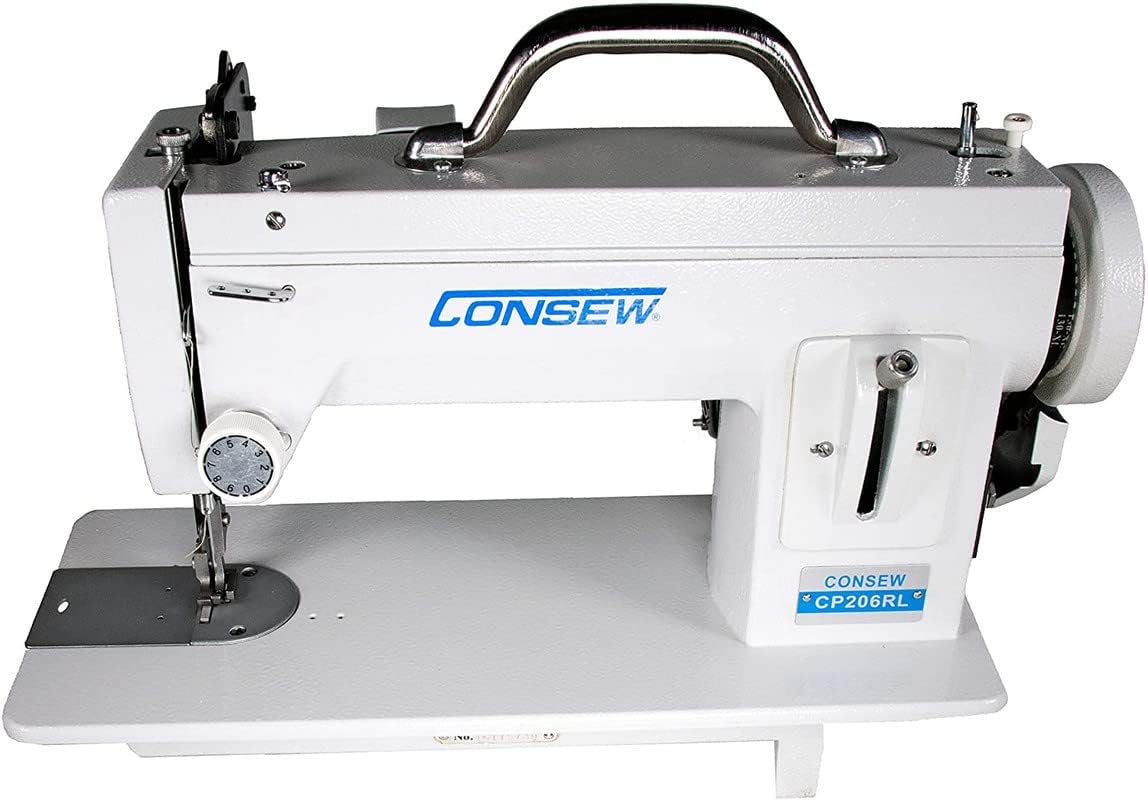
Verdict: real walking foot industrial performance in a smaller, table-top footprint.
Who it's for: makers who want the walking foot feed of a full industrial machine without dedicating floor space to a full standing table setup.
The CP206RL is a portable version of Consew's well-known walking foot design, giving it the same upper-and-lower feed mechanism that handles thick, multi-layer leather without slipping, but in a compact table-top form factor that can be stored between uses. It carries a 3.6-star rating across 192 verified reviews; feedback commonly notes it needs proper tensioning and needle setup out of the box, which is typical for industrial-style machines shipped for home assembly rather than a reliability flaw in the mechanism itself. For makers without room for a full industrial table, it's the most practical way to get true walking foot performance.
Pros:
- Genuine walking foot mechanism in a portable, table-top size
- Can be stored away between projects unlike a full standing industrial table
- Handles multi-layer leather that would slip on a standard drop-feed machine
Cons:
- Requires more setup and tensioning knowledge out of the box than a home machine
- Lower average rating than the full-size Consew 206RB-5
Who should skip it: anyone with the space and budget for a permanent workshop setup will get more consistent long-term results from the full Consew 206RB-5 with its dedicated table and motor.
Buying guide: what actually matters in a leather sewing machine
Feed mechanism is the single biggest factor. A standard drop-feed machine relies on one set of feed dogs below the material, which works fine for fabric but tends to slip or stitch unevenly on stiff, thick leather. A walking foot machine moves the material from both above and below in sync, which is why every serious leather-focused machine on this list either has one or is explicitly marketed for lighter leather work only.
Motor power and stitches per minute determine what thickness you can actually sew. Home heavy-duty machines advertise "50% more power" over standard machines, which is enough for garment leather and light upholstery. True industrial servo motors, by contrast, are built for continuous multi-layer penetration and can run at several times the speed, which matters for volume more than raw thickness.
Needle and thread size matter as much as the machine itself. Even an industrial walking foot machine will skip stitches or snap needles on thick leather if it's threaded with fabric-weight thread and a standard sharp needle. Leather-specific needles have a wedge point designed to cut through the hide rather than push between fibers like a fabric needle does.
Table and motor setup affects real-world usability more than spec sheets suggest. Machines that ship as a complete set with a table and servo motor, rather than a bare head, save significant setup time and reduce the risk of mismatching a motor to a head that was never designed to work together.
Review volume is a genuine signal, not just a vanity number. A machine with 400 verified reviews and a 4.4-star average has a far more reliable track record than one with 5 reviews at the same rating, particularly for mechanical products where early manufacturing defects tend to surface in reviews over time.
Final verdict
For most people, the SINGER 4452 Heavy Duty Sewing Machine is the pick: real leather-handling power, a massive verified review base, and a price that doesn't require a dedicated workshop. If you're regularly working with thick, multi-layer leather like saddlery or tack, the Consew 206RB-5 Walking Foot Industrial is worth the jump; its true walking foot feed solves the slipping problem that no home machine, including the 4452, can fully avoid.
Frequently asked questions
What kind of sewing machine do I need for thick leather?
You need a heavy duty or industrial machine with strong needle piercing power, ideally with a walking foot feed system. A walking foot moves the material from both above and below the needle, which prevents the slipping and uneven stitching that thick, stiff leather causes on a standard drop-feed machine.
Can a regular home sewing machine sew leather?
A standard home machine can struggle with anything beyond very thin leather because it lacks the piercing power and feed strength needed. A heavy duty home machine like the SINGER 4452 or 4411 can handle garment-weight leather and light upholstery, but true multi-layer or saddlery-grade leather needs an industrial walking foot machine.
What is a walking foot and why does it matter for leather?
A walking foot uses feed dogs both above and below the fabric to move thick or multiple layers of material evenly through the machine. Without one, stiff leather tends to slip under a standard presser foot, causing skipped stitches and uneven seam lengths.
Do I need special needles and thread for sewing leather?
Yes. Leather needles have a wedge-shaped point that cuts through the hide instead of pushing between fibers like a standard sharp needle. Using fabric-weight thread and a regular needle on thick leather is a common cause of skipped stitches and needle breakage, even on a capable machine.
Is an industrial sewing machine worth it for a home leather hobby?
It depends on volume and thickness. If you're only repairing belts or wallets occasionally, a heavy duty home machine like the SINGER 4452 is enough. If you're regularly working with thick, multi-layer leather such as saddlery or tack, an industrial walking foot machine like the Consew 206RB-5 pays for itself in reliability and reduced skipped stitches.
What's the difference between the SINGER 4411 and 4452 for leather work?
Both share the same heavy duty motor and metal frame, but the 4452 has more built-in stitches (32 versus 11) and a faster 1-step buttonhole compared to the 4411's 4-step buttonhole. For leather-specific work the piercing power is nearly identical, so the 4411 is a solid budget choice if you don't need the extra stitch options.


