
6 Best Sewing Machines for Beginners in 2026 (Brother and Singer Picks)
Real Amazon data on six beginner-friendly sewing machines, from the all-round Brother CS7000X to the budget-friendly Brother XM2701.
In this article
- Who this guide is for
- Top picks at a glance
- How we chose these sewing machines
- Sewing machine comparison table
- Brother CS7000X: Best Overall
- Brother XM2701: Best Budget
- Singer Heavy Duty 4423: Best for Heavy Fabrics
- Brother ST371HD: Most Durable
- Singer M3500: Most Portable
- Brother SE700: Best Upgrade Pick
- Buying guide: what actually matters in a sewing machine
- Final verdict
Who this guide is for
This guide is for anyone picking up sewing for the first time and trying to find the best sewing machine for beginners without wading through hundreds of confusing spec sheets. We evaluated computerized and mechanical machines across a range of prices, pulling real stitch counts, verified customer ratings, and review volume to see which models actually hold up for someone learning straight stitches, hems, and basic garment repair. Whether you want a simple mechanical workhorse or a computerized machine with guided features, these six picks cover the realistic starting points for a first machine in 2026.
Top picks at a glance
| Award | Product | Best for | |
|---|---|---|---|
| 🏆 Best Overall |  Brother CS7000X Brother CS7000X | Beginners who want room to grow into quilting | Check Price on Amazon |
| 💰 Best Budget |  Brother XM2701 Brother XM2701 | First-time sewers on a tight budget | Check Price on Amazon |
| 💪 Best for Heavy Fabrics |  Singer Heavy Duty 4423 Singer Heavy Duty 4423 | Denim, canvas, and thick layers | Check Price on Amazon |
| 🛡️ Most Durable |  Brother ST371HD Brother ST371HD | Frequent, jam-resistant everyday use | Check Price on Amazon |
| ✈️ Most Portable |  Singer M3500 Singer M3500 | Sewing classes and small spaces | Check Price on Amazon |
| ✨ Best Upgrade Pick |  Brother SE700 Brother SE700 | Beginners who also want embroidery | Check Price on Amazon |
How we chose these sewing machines
- Stitch count and usefulness, not just the number. We looked for a practical range of straight, zigzag, stretch, and buttonhole stitches rather than machines that pad the spec sheet with decorative stitches a beginner will rarely use.
- Verified review volume and rating. Every machine below has thousands (or in one case, hundreds) of real, verified Amazon customer reviews, which is the best available signal for long-term reliability on a first machine.
- Ease of threading and setup. Automatic needle threaders, clear tension dials, and included instructional material matter more to a beginner than raw stitch speed.
- Included accessories. Extra presser feet, bobbins, and a hard case affect real out-of-box value, especially at the budget end.
- Build quality for the fabric you'll actually sew. A machine that's great on quilting cotton can bog down on denim, so we noted which models handle heavier fabric confidently.
- None of these machines will produce clean, professional-looking seams without the right needle and thread tension for your fabric, so budget time to learn basic machine setup regardless of which model you choose.
Sewing machine comparison table
| Product | Key spec | Rating | Reviews | ||
|---|---|---|---|---|---|
| Brother CS7000X | 70 built-in stitches, LCD display | 4.6★ | 3,600 | Check Price on Amazon | |
| Brother XM2701 | 27 built-in stitches, auto threader | 4.6★ | 19,100 | Check Price on Amazon | |
| Singer Heavy Duty 4423 | 23 stitches, metal frame, 1100 stitches/min | 4.5★ | 21,200 | Check Price on Amazon | |
| Brother ST371HD | 37 stitches, jam-resistant, heavyweight | 4.5★ | 2,800 | Check Price on Amazon | |
| Singer M3500 | 32 stitches, lightweight portable | 4.4★ | 1,400 | Check Price on Amazon | |
| Brother SE700 | 103 stitches + 135 embroidery designs, wireless LAN | 4.5★ | 1,000 | Check Price on Amazon |
Brother CS7000X: Best Overall
Verdict: The most well-rounded computerized machine for a beginner who wants to keep learning past basic hems.
Who it's for: New sewers who want a computerized machine with enough stitches and accessories to grow from garment repairs into quilting projects.
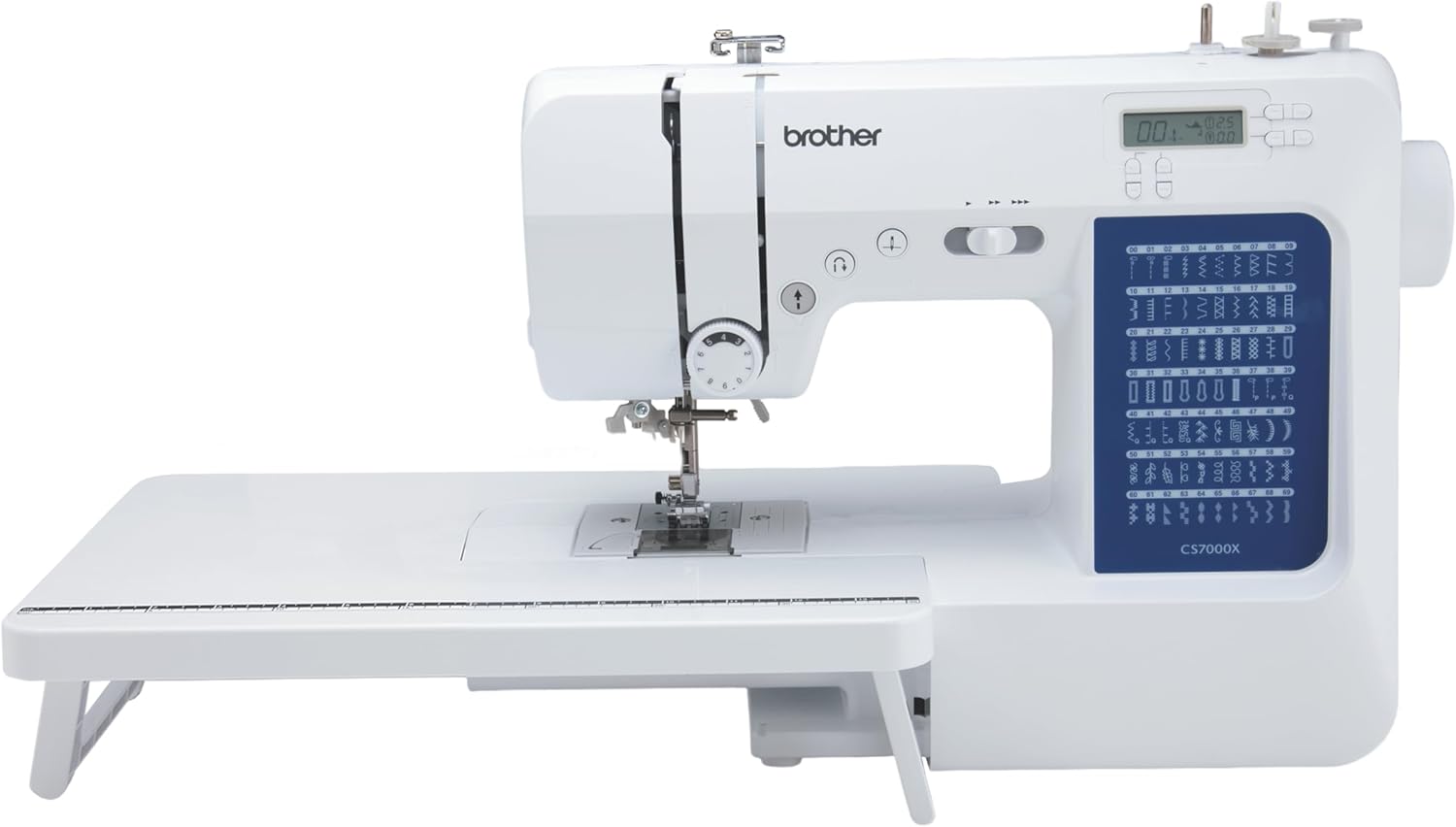
The CS7000X ships with 70 built-in stitches, an LCD display for stitch selection, a wide table for larger projects, and 10 included presser feet, which covers zippers, buttonholes, and blind hems out of the box without buying extra attachments. It carries an Amazon "Overall Pick" badge and holds a 4.6-star rating across 3,600 verified reviews, with more than 1,000 units bought in the past month alone, a strong signal of sustained demand rather than a short-lived spike. The automatic needle threader and drop-in bobbin system make it noticeably easier to get sewing quickly compared to older mechanical designs.
Pros:
- 70 stitches and a wide table cover quilting and garment work
- 10 included feet reduce the need for separate accessory purchases
- Automatic needle threader speeds up setup for beginners
Cons:
- Heavier and bulkier than the portable picks on this list
- The LCD display, while helpful, has a learning curve for total sewing newcomers
Who should skip it: If you want the absolute simplest machine to learn on with zero digital menus, the Brother XM2701 below is a more direct, mechanical-feeling experience.
Brother XM2701: Best Budget

Verdict: The best low-cost entry point that still includes a real needle threader and six sewing feet.
Who it's for: Anyone who wants to try sewing without a big upfront investment but doesn't want to sacrifice basic conveniences.
At roughly a third the price of the CS7000X, the XM2701 still includes an automatic needle threader, a free arm for cuffs and sleeves, and six interchangeable presser feet across 27 built-in stitches. It is the most reviewed machine on this list by a wide margin, with 19,100 ratings averaging 4.6 stars, which gives buyers an unusually large sample size to judge long-term reliability from. It's a genuinely lightweight, portable machine that many sewing classes use as a first purchase because it keeps the controls simple.
Pros:
- 19,100 reviews at 4.6 stars is the largest, most reassuring sample on this list
- Automatic needle threader and free arm included at a budget price
- Lightweight and portable for storage in small spaces
Cons:
- Only 27 stitches, fewer decorative and specialty options than pricier models
- Plastic-heavy build feels less substantial under sustained daily use
Who should skip it: If you plan to sew thick fabric like denim or upholstery regularly, choose the Singer Heavy Duty 4423 instead, which is built with a metal frame for exactly that.
Singer Heavy Duty 4423: Best for Heavy Fabrics

Verdict: The most powerful motor and sturdiest frame here, built for denim, canvas, and multi-layer projects.
Who it's for: Beginners whose projects lean toward heavier materials like denim jackets, tote bags, or upholstery repair rather than delicate quilting cotton.
The 4423 runs on a metal internal frame with 50% more power than a standard home machine, delivering 1,100 stitches per minute and 23 built-in stitches covering 97 applications. It's the most-reviewed sewing machine in this roundup with 21,200 ratings at a 4.5-star average, a volume that reflects years of sustained sales as a go-to "heavy duty" pick rather than a niche product. The stronger motor and piercing power mean it plows through thick seams that would stall a lighter machine, though that same power means beginners should practice on scrap fabric first to get a feel for the speed.
Pros:
- Metal frame and 50% more motor power than standard machines
- 21,200 reviews at 4.5 stars, the deepest track record on this list
- 1-step buttonhole and high stitch speed for faster project completion
Cons:
- The extra power can feel intense for someone sewing lightweight fabric like chiffon
- Heavier overall unit than the portable picks, less ideal for frequent travel to classes
Who should skip it: If your projects are mostly quilting cotton, knits, or garments rather than heavy fabric, the Brother CS7000X gives you more stitch variety for that kind of work.
Brother ST371HD: Most Durable

Verdict: A jam-resistant, heavyweight-built machine designed to survive frequent, everyday beginner use.
Who it's for: Sewers who want a machine they can use several times a week without worrying about thread jams or mechanical wear.
The ST371HD is marketed specifically as strong and tough, with a heavyweight metal body, jam-resistant design, and 37 built-in stitches across a free arm for cuffs and pant hems. It holds a 4.5-star rating from 2,800 verified reviewers, and Brother positions it explicitly for "beginners and seasoned sewers" alike, which shows in the balance between simple controls and durable construction. The automatic needle threader remains included even at this reinforced build tier, so durability doesn't come at the cost of beginner-friendliness.
Pros:
- Jam-resistant design reduces one of the most common beginner frustrations
- Heavyweight build intended for frequent, long-term daily use
- Automatic needle threader and free arm included
Cons:
- Fewer built-in stitches (37) than the CS7000X's 70
- No LCD screen, so stitch selection is manual rather than digital
Who should skip it: If you specifically want digital stitch selection and a wide table for larger projects, the Brother CS7000X is the better computerized alternative.
Singer M3500: Most Portable

Verdict: The lightest, most grab-and-go machine on this list, built for sewing classes and small apartments.
Who it's for: Beginners taking an in-person sewing class, or anyone with limited storage space who needs to pack the machine away between uses.
The M3500 is a genuinely lightweight, portable design offering 32 stitches across 110 stitch applications, a one-step buttonhole, and an LED work light, all packed into a compact accessory kit. It holds a 4.4-star rating from 1,400 reviewers, a smaller but still solid sample that reflects its more recent, niche-portable positioning compared to Singer's older heavy duty line. The trade-off for portability is a lighter overall build, so it suits lighter fabrics like cotton and knits better than upholstery-weight material.
Pros:
- Genuinely lightweight and easy to carry to classes or store away
- One-step buttonhole and LED light simplify common beginner tasks
- 110 stitch applications from just 32 built-in stitches
Cons:
- Lighter build isn't ideal for heavy fabric or frequent daily use
- Smaller review sample (1,400) than the higher-volume Brother and Singer heavy-duty picks
Who should skip it: If durability under frequent use matters more to you than portability, the Brother ST371HD is the sturdier choice.
Brother SE700: Best Upgrade Pick

Verdict: A combined sewing and embroidery machine for beginners who want to grow into embroidery without buying a second machine later.
Who it's for: Beginners with a bit more budget who want built-in embroidery capability alongside standard sewing, rather than upgrading machines down the line.
The SE700 pairs 103 sewing stitches with 135 built-in embroidery designs, a 4-inch by 4-inch embroidery hoop, wireless LAN connectivity for importing designs, and a 3.7-inch touchscreen display for navigating both modes. It holds a 4.5-star rating across 1,000 reviews, and Brother explicitly markets it as suited to "advanced and beginner" sewers, reflecting the two-in-one design. This is a meaningful step up in both price and complexity from the other machines here, so it makes most sense for someone confident they'll actually use the embroidery side rather than treating it as a novelty.
Pros:
- Combined sewing and embroidery functionality in one machine
- Touchscreen and wireless design import streamline embroidery projects
- 103 built-in stitches keep the sewing side fully featured too
Cons:
- Meaningfully more expensive than the other five picks
- The added embroidery menus mean a steeper learning curve for absolute beginners
Who should skip it: If you only want to learn straight sewing and have no interest in embroidery, the Brother CS7000X delivers more sewing-focused value for less money.
Buying guide: what actually matters in a sewing machine
Automatic needle threader. Threading a needle by hand is one of the most common early frustrations for beginners, especially with lower vision or shakier hands. Almost every machine on this list includes one, and it's worth prioritizing if you're comparing models not covered here.
Stitch count versus stitch usefulness. A machine advertising 200 stitches usually only differs from a 30-stitch machine by decorative variations. For beginners, prioritize a solid straight stitch, zigzag, stretch stitch, and buttonhole function over a large but redundant stitch library.
Frame material. Metal-frame machines like the Singer Heavy Duty 4423 hold tension and alignment better over years of use and heavier fabric than mostly plastic-bodied machines, though plastic bodies keep weight and cost down for lighter, occasional use.
Bobbin system. A drop-in, top-loading bobbin is easier for beginners to manage and troubleshoot than a front-loading bobbin case, which requires more careful tension adjustment.
Included accessories. Extra presser feet (zipper, buttonhole, blind hem), bobbins, needles, and a hard case add real value and reduce how much you'll need to spend right after your first purchase.
Portability needs. If you're taking a class or have limited storage, weight and a carrying handle matter as much as stitch count. If the machine lives permanently on a desk, a heavier, sturdier build is usually the better trade-off.
Final verdict
For most beginners, the Brother CS7000X is the strongest overall pick: it balances a genuinely useful 70-stitch library, a wide table, and a full accessory set at a price that still makes sense for a first machine. If budget is the deciding factor, the Brother XM2701 delivers the essentials (auto threader, free arm, six feet) backed by the largest, most reassuring review count on this list.
Frequently asked questions
What is the best sewing machine for a total beginner?
The Brother CS7000X is our top overall pick for beginners because it includes 70 built-in stitches, an automatic needle threader, and 10 presser feet, giving new sewers room to grow from simple hems into quilting projects without needing a second machine soon after buying their first.
Should a beginner buy a mechanical or computerized sewing machine?
Either works well for beginners. Mechanical machines like the Brother XM2701 are simpler and cheaper, while computerized machines like the Brother CS7000X add an LCD display for stitch selection. Choose mechanical if you want the simplest possible learning curve, or computerized if you want more built-in stitch variety.
How much should I spend on my first sewing machine?
A solid beginner machine with an automatic needle threader and a handful of presser feet typically costs between $130 and $275. The Brother XM2701 is a strong budget option under $150, while the Brother CS7000X sits around $270 and offers significantly more built-in stitches.
What sewing machine handles thick fabric like denim best?
The Singer Heavy Duty 4423 is built with a metal frame and 50% more motor power than a standard home machine, making it the best pick on this list for denim, canvas, and other heavy or multi-layer fabrics.
Do I need a machine with embroidery built in?
Only if you specifically want to combine embroidery with your sewing. The Brother SE700 adds 135 built-in embroidery designs and a touchscreen display, but it costs meaningfully more than sewing-only machines, so it is best reserved for buyers confident they will use the embroidery function.
What features matter most for a first sewing machine?
Prioritize an automatic needle threader, a drop-in top-loading bobbin, a solid straight and zigzag stitch, and at least a basic buttonhole function. Extra decorative stitches and high stitch counts matter far less to a beginner than these core, everyday features.


