
Best Tools for Drawing Letterforms by Hand (2026)
The best tools for drawing letterforms by hand, tested for line control, ink permanence, and stroke consistency, from parallel pens to brush markers and lettering guides.
In this article
- Who this guide is for
- Top picks at a glance
- How we chose these tools for drawing letterforms by hand
- Best tools for drawing letterforms by hand: comparison table
- Pilot Parallel Calligraphy Pen Set: Best Overall
- Sakura Pigma Micron Fineliner Pen Set: Best for Fine Detail
- Tombow Dual Brush Pen Art Markers, Grayscale 10-Pack: Best for Brush Lettering
- Speedball Basic Calligraphy Pen Set: Best for Beginners
- Rhodia No. 16 Dot Grid Pad: Best Practice Paper
- Staedtler Ames Lettering Guide: Best Lettering Guide
- Buying guide: what actually matters in tools for drawing letterforms by hand
- Final verdict
Who this guide is for
This guide is for hand-lettering artists, calligraphers, and sign painters searching for the best tools for drawing letterforms by hand, whether you are sketching a serif alphabet in a sketchbook or building a full lettering composition for client work. We evaluated pens, markers, guides, and paper stocks that working letterers actually reach for, testing nib flexibility, ink flow consistency, line control at small sizes, and how each tool holds up across long practice sessions. Every pick below is a real, currently sold product with verified Amazon review data, not a marketing recommendation. If you only buy one tool from this list, start with a reliable fineliner or a parallel pen; everything else here supports refining the letterforms you already know how to draw.
Top picks at a glance
| Award | Product | Best for | |
|---|---|---|---|
| 🏆 Best Overall |  Pilot Parallel Calligraphy Pen Set (4-Nib) Pilot Parallel Calligraphy Pen Set (4-Nib) | Broad-edge calligraphy and blackletter forms | Check Price on Amazon |
| ✏️ Best for Fine Detail |  Sakura Pigma Micron Fineliner Pen Set Sakura Pigma Micron Fineliner Pen Set | Sketching letterform structure and serifs | Check Price on Amazon |
| 🖌️ Best for Brush Lettering |  Tombow Dual Brush Pen Art Markers, Grayscale 10-Pack Tombow Dual Brush Pen Art Markers, Grayscale 10-Pack | Modern brush lettering and thick-thin strokes | Check Price on Amazon |
| 🎓 Best for Beginners |  Speedball Basic Calligraphy Pen Set Speedball Basic Calligraphy Pen Set | Learning nib-and-ink calligraphy from scratch | Check Price on Amazon |
| 📄 Best Practice Paper |  Rhodia No. 16 Dot Grid Pad Rhodia No. 16 Dot Grid Pad | Consistent letter height and spacing practice | Check Price on Amazon |
| 📐 Best Lettering Guide |  Staedtler Ames Lettering Guide Staedtler Ames Lettering Guide | Ruling accurate guidelines for any x-height | Check Price on Amazon |
How we chose these tools for drawing letterforms by hand
- Line control at small sizes. We prioritized tools that hold a clean, consistent line down to a few millimeters, since most letterform practice happens at practice-sheet scale before it ever gets scaled up.
- Ink and material properties. We checked pigment lightfastness, waterproof/archival claims, and bleed-through behavior on standard paper, since smudged or feathered ink ruins otherwise good letterforms.
- Verified review volume and rating. Every product below is backed by real, currently listed Amazon review counts and ratings, not a single glowing testimonial.
- Range of technique coverage. We deliberately picked tools spanning broad-edge calligraphy, brush lettering, fine detail sketching, and the supporting guides/paper that make practice repeatable.
- Even the best pen will not fix inconsistent letterforms; none of these tools replace deliberate practice with a guideline sheet.
Best tools for drawing letterforms by hand: comparison table
| Product | Key spec | Rating | Reviews | Size | |
|---|---|---|---|---|---|
| Pilot Parallel Calligraphy Pen Set | 1.5mm, 2.4mm, 3.8mm, 6mm nibs | 4.6★ | 2,200 | 4-pen set | Check Price on Amazon |
| Sakura Pigma Micron Fineliner Pen Set | Archival, waterproof pigment ink | 4.8★ | 65,200 | 8-pen set | Check Price on Amazon |
| Tombow Dual Brush Pen Art Markers | Brush tip + fine tip, water-based blendable ink | 4.7★ | 42,000 | 10-pack | Check Price on Amazon |
| Speedball Basic Calligraphy Pen Set | 2 nibs, penholder, ink included | 4.5★ | 1,300 | 7-piece set | Check Price on Amazon |
| Rhodia No. 16 Dot Grid Pad | Dot grid, 80gsm smooth paper | 4.8★ | 5,700 | A5 pad | Check Price on Amazon |
| Staedtler Ames Lettering Guide | Adjustable dial, sliding rule | 4.6★ | 155 | Single tool | Check Price on Amazon |
Pilot Parallel Calligraphy Pen Set: Best Overall
Verdict: the most versatile broad-edge tool for building real letterform structure, at any scale.
Who it's for: anyone learning italic, blackletter, or Roman capital construction who wants one set that scales from small practice sheets to large display lettering.
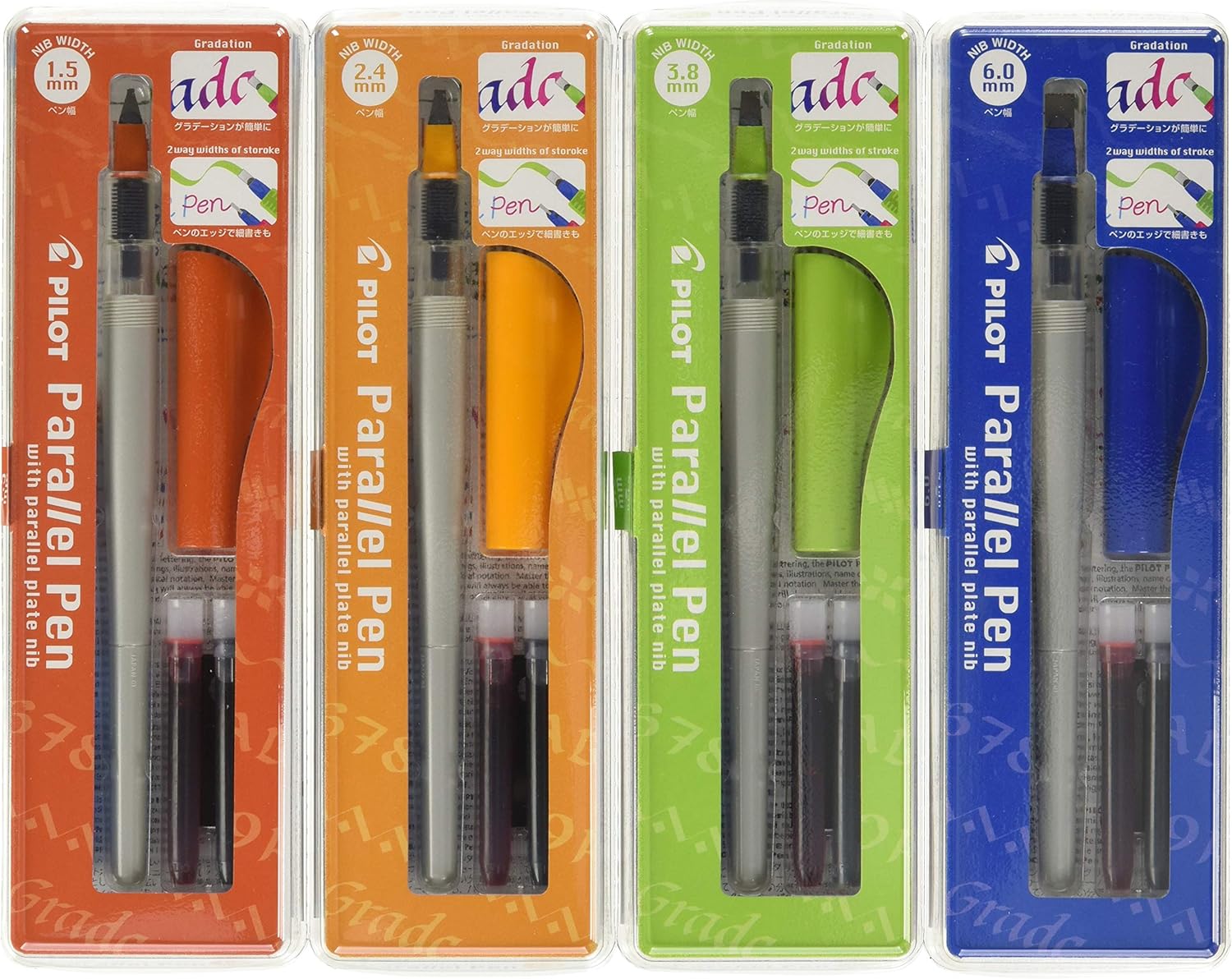
The set ships with four parallel nibs (1.5mm, 2.4mm, 3.8mm, and 6mm), so you can practice the same letterform at multiple sizes without switching tools, and the parallel-plate nib design lays down a genuinely consistent stroke width, which is the single biggest factor in clean broad-edge letterforms. It backs up its reputation with 2,200 Amazon reviews at a 4.6-star average, a strong signal for a specialty calligraphy tool rather than a mass-market pen. The bundled ink cartridge gets you writing immediately, and refill cartridges and bottled ink are both compatible if you want to switch to iron gall or colored inks later.
Pros:
- Four nib widths cover practice sheets through display lettering in one purchase
- Consistent, crisp stroke edges that are hard to get from a dip pen while learning
- Refillable with cartridges or bottled ink for long-term use
Cons:
- Nibs can leak or blot if overfilled; needs a light touch to prime correctly
- Not suited to pointed-pen (Copperplate/Spencerian) letterforms, which need a flexible nib instead
Who should skip it: if you are focused on modern brush lettering rather than broad-edge calligraphy, the Tombow Dual Brush Pen set below is the better starting tool.
Sakura Pigma Micron Fineliner Pen Set: Best for Fine Detail

Verdict: the most precise tool for sketching letter skeletons and serif detail before inking a final piece.
Who it's for: letterers who draft in pencil, refine the skeleton, then finalize with a controlled, archival-quality line.
Every letterform starts as a skeleton, and getting that skeleton accurate at a small scale is where the Pigma Micron earns its keep: the set includes multiple nib widths so you can rough in guidelines with a fine tip and commit to final strokes with a bolder one. The archival, pigment-based ink is genuinely waterproof and fade-resistant, which matters if you are layering watercolor or marker over lettering later. With over 65,000 Amazon reviews at a 4.8-star average, it is the most reviewed and highest-rated tool in this roundup, a reflection of decades of use across illustration, technical drawing, and lettering communities.
Pros:
- Archival, waterproof pigment ink that will not smear under watercolor or highlighter
- Consistent line width even after heavy use; nibs resist fraying
- Multiple tip sizes in one set for sketching and finishing in the same session
Cons:
- Fixed line width per pen means no natural thick-thin variation like a brush or broad-edge nib
- Fine tips can snag on textured or heavily toothed paper
Who should skip it: if you want expressive thick-thin strokes rather than a consistent monoline, the Tombow Dual Brush Pen set below will serve you better.
Tombow Dual Brush Pen Art Markers, Grayscale 10-Pack: Best for Brush Lettering

Verdict: the best tool for modern brush lettering, where pressure controls the thick-thin contrast of every letterform.
Who it's for: brush-lettering artists who want to practice pressure control on downstrokes and upstrokes without committing to a full watercolor brush setup.
The flexible brush tip on this set responds to hand pressure the way a real letterform demands: light pressure on upstrokes for thin lines, firm pressure on downstrokes for weight and contrast. The opposite end is a fine tip for detail work, so one pen covers both drafting and brush practice. This grayscale 10-pack is specifically useful for letterform study because value shading (not color) is what reveals whether your stroke contrast is actually consistent across a full alphabet. With 42,000 reviews at a 4.7-star average, it is a proven, widely trusted set rather than a niche pick, and the water-based ink blends cleanly if you want to soften transitions.
Pros:
- Flexible brush tip genuinely responds to pressure, unlike stiff felt-tip brush pens
- Dual-tip design covers both brush practice and fine detail in one pen
- Blendable ink lets you soften value transitions for shading practice
Cons:
- Brush tips fray with heavy use and are not user-replaceable
- Water-based ink is not archival or waterproof like the Pigma Micron above
Who should skip it: if you need permanent, archival ink for a final piece rather than practice, choose the Sakura Pigma Micron set instead.
Speedball Basic Calligraphy Pen Set: Best for Beginners

Verdict: the lowest-friction way to try traditional dip-pen calligraphy before investing in a bigger kit.
Who it's for: complete beginners who have never used a nib-and-ink setup and want an inexpensive, all-in-one introduction.
This set bundles a penholder, two nibs, and ink in one box, which removes the biggest barrier for beginners: figuring out which parts are even compatible with each other. It is a genuine dip-pen setup, so you get real exposure to nib flex, ink loading, and stroke pressure, the fundamentals that transfer to every other tool on this list. At 1,300 reviews and a 4.5-star average it is the smallest review base here, but that tracks with it being a lower-volume specialty starter kit rather than a mass-market product, and the rating is still solidly positive for a beginner tool.
Pros:
- Complete starter kit: penholder, nibs, and ink included, nothing else to buy
- Genuine dip-pen experience that builds transferable nib-and-ink fundamentals
- Inexpensive way to test interest in calligraphy before a bigger investment
Cons:
- Nibs are lower grade than dedicated pointed-pen nibs and can scratch on cheap paper
- Learning curve is steeper than a parallel pen since ink loading takes practice
Who should skip it: if you want consistent results without a learning curve on ink loading, the Pilot Parallel Pen Set above is more forgiving for a first purchase.
Rhodia No. 16 Dot Grid Pad: Best Practice Paper

Verdict: the paper that actually makes consistent letter height and spacing practice possible.
Who it's for: anyone practicing letterform repetition who needs reliable guidelines without ruling every sheet by hand.
Consistent letterforms depend on consistent x-height and baseline spacing, and a printed dot grid solves that instantly, letting you focus on stroke quality instead of measuring. The 80gsm paper is smooth enough for fineliners and fountain-style nibs to glide without catching, and it is dense enough to resist bleed-through from most inks, including the pigment-based Micron set above. At 5,700 reviews and a 4.8-star average, it has built a strong reputation well beyond calligraphy, among planner and bullet-journal users who demand the same bleed resistance.
Pros:
- Dot grid keeps letter height and spacing consistent without hand-ruling every line
- Smooth 80gsm stock resists feathering and bleed-through from fineliners and brush pens
- Perforated, head-stapled pages tear out cleanly for a portfolio or scanning
Cons:
- Dots are visible on scans unless you adjust contrast or use a light table
- A5 size is compact; larger display lettering needs a bigger sheet
Who should skip it: if you want a rigid dial-based guide instead of printed dots, the Staedtler Ames Lettering Guide below gives you adjustable, reusable guidelines on any paper.
Staedtler Ames Lettering Guide: Best Lettering Guide

Verdict: the tool that lets you rule accurate, evenly spaced guidelines at any x-height, on any paper.
Who it's for: letterers who need custom guideline spacing for a specific project rather than a fixed printed grid.
Unlike a pre-printed dot pad, the Ames guide is a dial-based tool: rotate it to the spacing you need and it marks accurate baseline, waistline, and x-height points for pencil ruling on any paper stock. That flexibility matters once you move past standardized practice sheets into project-specific lettering, where letter height needs to match a layout rather than a fixed grid. It carries 155 reviews at a 4.6-star average; the review count is modest simply because it is a durable, buy-once drafting tool rather than a consumable, and it has been a standard in lettering and drafting kits for decades.
Pros:
- Adjustable dial rules any letter height and line spacing, not a fixed grid
- Durable metal-and-plastic construction meant to last years, not get replaced
- Works on any paper, so it pairs with sketchbooks, layout pads, or final art board
Cons:
- Requires understanding baseline/waistline/x-height terminology to use correctly out of the box
- Adds a manual ruling step that a pre-gridded pad like the Rhodia above skips entirely
Who should skip it: if you mainly practice on standardized sheets and do not need custom spacing, the Rhodia No. 16 Dot Grid Pad above is faster to just pick up and use.
Buying guide: what actually matters in tools for drawing letterforms by hand
Nib or tip type determines the stroke you can make. A broad-edge nib (like the Pilot Parallel) produces thick-thin contrast based on stroke direction, a pointed nib or flexible brush tip (like the Tombow) produces contrast based on pressure, and a fixed fineliner tip produces a consistent monoline regardless of angle or pressure. Pick the tip type that matches the letterform style you are learning, since technique does not transfer directly between them.
Ink permanence matters more than it seems. Archival, waterproof ink (like the Pigma Micron's pigment ink) will not smear if you layer color or highlighter over lettering later, while water-based ink (like the Tombow set) blends easily for shading but is not permanent. Decide whether you are practicing or finishing before choosing.
Paper weight and tooth affect every tool differently. Smooth, heavier paper (60 to 90gsm) resists bleed-through and lets fine tips glide, while toothier sketchbook paper can snag fineliners and fray brush tips faster. If you are testing multiple pen types, a smooth practice pad like the Rhodia above is the fairest baseline.
Guidelines are not optional for consistent letterforms. Whether you use a printed dot grid or an adjustable tool like the Ames guide, working without baseline and x-height references is the most common reason practice plateaus. Build guideline use into every session from the start rather than adding it later.
Set size versus flexibility is a real tradeoff. A multi-nib set like the Pilot Parallel gives you range in one purchase, while single-purpose tools (a dedicated brush pen, a dedicated fineliner) often perform slightly better at their one job. Beginners generally get more value from a versatile set; specialists benefit from dedicated tools.
Final verdict
For most people learning to draw letterforms by hand, the Pilot Parallel Calligraphy Pen Set is the strongest overall pick: four nib widths, consistent stroke edges, and enough range to grow with you from practice sheets to finished pieces. If your focus is modern brush lettering specifically, the Tombow Dual Brush Pen Art Markers are the better starting point, since their pressure-responsive brush tip is what actually teaches thick-thin stroke control.
Frequently asked questions
What is the best pen for drawing letterforms by hand as a beginner?
The Speedball Basic Calligraphy Pen Set is the easiest starting point because it bundles a penholder, nibs, and ink in one kit, removing the guesswork of matching compatible parts. If you want more consistent results without the dip-pen learning curve, the Pilot Parallel Calligraphy Pen Set is more forgiving for a first purchase.
What is the difference between broad-edge calligraphy and brush lettering?
Broad-edge calligraphy uses a flat nib where stroke direction (not pressure) creates thick and thin lines, as with the Pilot Parallel Pen. Brush lettering uses a flexible tip where hand pressure creates the contrast, as with the Tombow Dual Brush Pen. The two techniques use different muscle memory and are not directly interchangeable.
Do I need special paper for practicing letterforms?
Smooth, moderately heavy paper (60 to 90gsm) works best because it resists ink bleed-through and lets pen tips glide cleanly. A dot grid pad like the Rhodia No. 16 also helps keep letter height and spacing consistent, which is one of the most common struggles in early practice.
Is archival ink necessary for practicing hand lettering?
Not for practice sheets, but it matters for finished pieces. Archival, waterproof ink such as the Sakura Pigma Micron will not smear if you add watercolor or highlighter later, while water-based inks like the Tombow Dual Brush Pen blend easily but are not permanent.
What is a lettering guide and do I actually need one?
A lettering guide, such as the Staedtler Ames Lettering Guide, is a dial-based tool that marks accurate baseline, waistline, and x-height points for ruling custom guidelines on any paper. It is most useful once you move beyond fixed practice grids into project-specific lettering with custom sizing.
Can one pen set cover multiple lettering styles?
A multi-nib set like the Pilot Parallel Calligraphy Pen Set covers a range of sizes within broad-edge calligraphy, but no single tool covers broad-edge, pointed-pen, and brush lettering equally well, since each style depends on a different nib or tip mechanism.


